New Forest Online Website design in the New forest | add your business to the portal database to direct traffic to your site Email us at info@newforest-online.co.uk
Email us at info@newforest-online.co.uk

About the New Forest


  • Artists & Art Galleries
  • Attractions
  • Activities
  • Accommodation
  • Eating Out
  • Getting Around
  • What's On
  • Useful Links
  • Tourist Home
  •  

    Introduction
    A brief history
    Flora and fauna
    The New Forest code

    Introduction

    The New Forest can be found in central southern England, and is undoubtedly one of the UK's premier tourist attractions, if not one of the world's. Every year, visitors from all walks of life come here to experience its natural beauty.

    Some New Forest families still practise their ancient Rights of Pasture by turning out their ponies, cattle, sheep and pigs to graze and browse the open forest. These animals help to maintain the forest's unique landscape - a landscape which continued grazing has shaped over the last 900 years. Without them, the New Forest would not exist today.

    One special highlight is the thousands of wild ponies, which roam freely in the woodlands and open moorland, and which are frequently seen eating the grass at the side of the roads.

    The New Forest, with its wonderful collection of plants, birds and insects is now a national reserve, and is soon to become a National Park.

    A brief history

    The New Forest was created in 1079 by King William 1. For him it was an ideal hunting ground, covering over 200 square miles of ancient woodlands and heathlands and located close to the royal capital of Winchester. In the 14th century the royal interest in deer conservation diminished as the demand for timber increased. The new scale of timber production for ship building and fortifications prompted the inclosure of thousands of acres of forest land for timber growing.

    Today, after 900 years, more than 100 square miles of the forest is still owned by the Crown. This land is now administered by the Forestry Commission. The ancient system set in place to protect the woodlands and wilderness heaths still works today through the efforts of Verderers, Agisters and commoners - literally the judges, police and land users of the forest.

    Flora and fauna

    The New Forest is now recognized as one of the most unique and important wilderness areas in Western Europe. It comprises 140 square miles of a diverse range of landscapes - heaths, bogs, pine forests, moorland, and of course the ancient and ornamental beech and oak woodlands for which it is famous. There is no other area in lowland Britain that contains such a mix, and many of these habitats are increasingly rare.

    The amazing New Forest habitats are home to thousands of common and rare species of flora and fauna, including five different species of wild deer. It is estimated that nearly half of the 2,500 species of butterfly and moth in Britain have been found in the New Forest. In addition, 9 rare and 25 nationally scarce species of plant are recorded. Some of these, such as the wild gladiolus, are only found in the New Forest. There are also nationally important birds and rare reptiles, such as the sand lizard and the smooth snake.

    The forest is free for you to explore at your leisure and there is an extensive network of footpaths and cycle paths to help you do this. Alternatively, you can visit one of the many wildlife attractions (see attractions page for more details) - all of which provide organised events and activities to help you enjoy the Forest's natural treasures.

    The New Forest code

    Although the New Forest is a free and open place, there is a code you should observe whilst in the Forest area. This code has been implemented by the Forestry Commission and is there for the well-being of the Forest and for the safety of visitors. Preservation and long-term conservation are goals of the Forestry Commission and following their simple rules will help. In the New Forest the well-being of the animals and the special needs of the countryside come first.

    Roads
    Driving at 40mph or below on all unfenced forest roads greatly reduces the number of accidents involving ponies, cattle and deer - especially at night.

    Parking
    Parking on the roadside causes congestion and great damage to verges. Use one of the 150 Forest car parks, but remember to lock your car and take valuables with you.

    Cycling
    Cycling is extremely popular but also destructive if the cycle routes are not followed; please keep to marked paths and cycle tracks. Give way to walkers and horse-riders and please travel at moderate speeds and avoid wheel spins and skidding.

    Ponies
    Ponies are wild animals and should not be fed by visitors. Feeding the ponies encourages them to stray onto dangerous forest roads. Ponies and donkeys can also be very aggressive if approached, and young children are particularly at risk.

    Dogs
    Well behaved dogs are welcome in the New Forest, and will have a great time. A Dog Walking Code is available on line at www.forestry.gov.uk. The area is famed for its wildlife and of course you must not allow your dog to chase or worry the livestock, deer or birds. If you cannot be sure of controlling your dog keep it on a lead. Please respect other Forest users. In car parks where bins are provided please pick up after your dog.

    Access
    You may walk on any footpath or track unless it says otherwise. By keeping to paths you greatly reduce the risk of disturbance to wildlife and their habitats.

    Fire
    Fire is a great threat to habitats and wildlife. No picnic or camp fires are allowed but BBQ sites are provided by the Forestry Commission. To book, telephone the Forestry Commission on 023 8028 3141.

    Litter
    Litter should always be placed in litter bins or taken home with you.

       
    Quick search by town name:

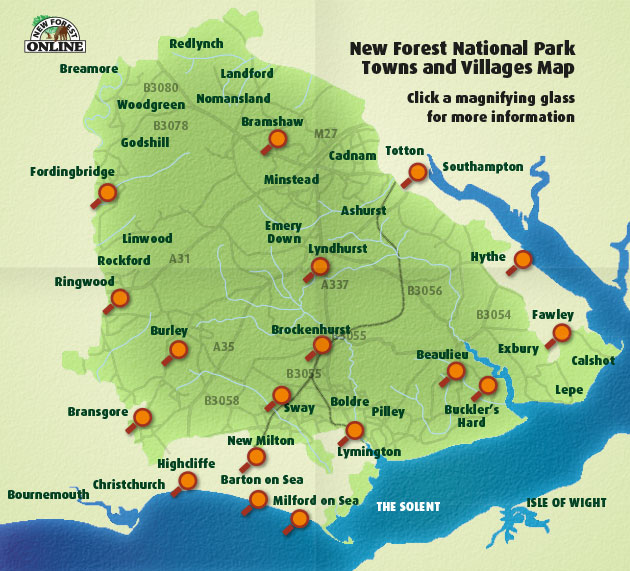
    Ashley | Avon | Bank | Barton | Beaulieu | Boldre | Bramshaw | Bransgore | Brockenhurst | Bucklers Hard | Burley | Blackfield | Brook | Brockhampton | burton | Bisterne | Bashley | Beckley | Burgate | Cadnam | Christchurch | Dibden | Dibden Purlieu | East End | Eling | Ellingham | Emery Down | Eveton | Exbury | Fawley | Fordingbridge | Furzey Lodge | Furze Hill | Frogham | Godshill | Highcliffe | Hordle | Hythe | Hill Top | Hightown | Hinton | Holbury | Holmsley | Kingston | Landford | Linford | Linbrook | Lymington | Lyndhurst | Matchams | Marchwood | Milford | Mockbeggar | Minstead | Netley Marsh | New Milton | Nomansland | Newtown | Ossemsley | Pennington | Ringwood | Setley | South Baddesley | Stoney Cross | Sopley | Somerley | Swan Green | Sway | Piley | Pooksgreen | Portmore | Tiptoe | Totton | Winsor | Walhampton | Walkford | Woodgreen
    We are a Chamber Member Rent the Villa Riviera in Cannes France
    Copyright © 2012 New Forest Online™ Ltd, All Rights Reserved.
    Use of this site indicates you accept the Terms of Use.

    New Forest Online Limited. Registered in England No. 4177937.
    VAT Reg. No: GB 760 3204 65.
    Office address: Londesborough House, 34 High Street, Lymington,
    Hants SO41 9AF.

    Registered Office: 7 Lynwood Court, Priestlands Place, Lymington, Hampshire SO41 9GA
    Site Map | Customer Websites
    We are a Chamber Member We are a Chamber of Commerce member